Queue Scheduling in Healthcare

One of the biggest challenges in healthcare scheduling isn’t whether open shifts can be filled; it’s how they’re offered.

Sending a targeted shift to everyone at once often creates problems:

  • Senior or high-performing staff feel overlooked
  • Managers manually escalate when no one responds
  • Fairness policies are hard to enforce consistently
  • Urgent shifts stall while managers chase replies

That’s why queue-based scheduling, also known as tiered shift distribution, has become a powerful tool for modern healthcare teams.

Queue based scheduling

What is Queue-based Shift Scheduling?

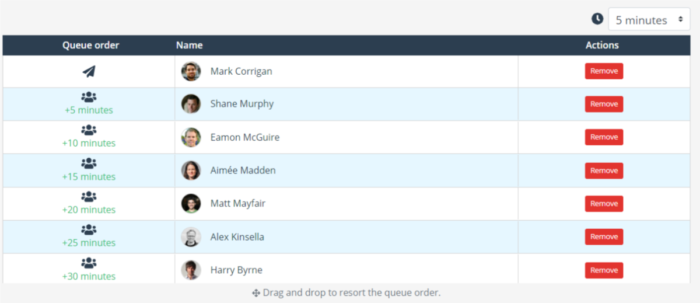
Queue scheduling allows healthcare managers to automatically send targeted shifts in waves, giving priority groups first access before expanding availability to additional staff.

Instead of repeatedly re-sending the same shift, the system escalates visibility based on:

  • Predefined employee groups
  • Timed response intervals
  • Clear rules for what happens when the queue ends

This creates a structured, fair, and predictable way to fill shifts.

How Queue Scheduling Works

  1. Create priority groups

Managers organise selected employees into tiers, such as:

  • Group 1
  • Group 2
  • Group 3

Each group represents a priority level based on seniority, experience, performance, or any internal policy.

  1. Set time intervals

Each group is given a defined window to respond before the shift is escalated.

For example:

  • Group 1: 30 minutes
  • Group 2: 30 minutes
  • Group 3: 30 minutes

This ensures priority access without delaying coverage.

  1. Automatic escalation

If no one accepts the shift within the interval:

  • The system automatically releases the shift to the next group
  • Managers don’t need to monitor responses or resend offers
  • The process continues until the shift is filled or the queue ends
  1. Optional conversion to Open

When the queue finishes, managers can choose to:

  • Convert the shift to Open, making it visible to all eligible staff
  • End the queue, stopping distribution entirely

This guarantees a fallback option for urgent coverage.

targeted shifts

Example: Tiered shift escalation in action

A common real-world scenario might look like this:

  • Send the shift to your top 5 preferred staff
  • Wait 30 minutes
  • Expand to 10 additional qualified staff
  • Wait another 30 minutes
  • Automatically open the shift to everyone eligible

Strategic queue scheduling scenarios

Seniority-based distribution

  • Group 1: Senior staff (10+ years)
  • Group 2: Mid-level staff (5–10 years)
  • Group 3: All other eligible staff

This supports union agreements and internal fairness policies while still ensuring coverage.

Performance-based rewards

  • Group 1: High performers and reliable responders
  • Group 2: Consistently available staff
  • Group 3: All eligible employees

Reliable staff are rewarded with early access — without manual favouritism.

queue-based shift distribution

Experience-appropriate escalation

  • Group 1: Experienced specialty nurses for complex cases
  • Group 2: Competent general staff if complexity allows
  • Group 3: Newer staff with supervision available
  • End: Convert to Open if acuity permits

This balances patient safety with practical staffing needs.

Geographic or proximity-based queues

  • Group 1: Staff who live closest
  • Group 2: Staff within a 30-minute commute
  • Group 3: All eligible employees

Ideal for urgent or last-minute coverage where response time matters.

Float pool optimisation

  • Group 1: Unit’s regular staff
  • Group 2: Float pool with unit experience
  • Group 3: Float pool with minimal unit exposure

This prioritises continuity of care before expanding reach.

open shifts

Why Queue Scheduling Matters in Healthcare

  • Automates escalation procedures
    No need to manually check responses or resend shifts — the system manages the rollout.
  • Honours contractual and policy obligations
    Easily comply with seniority rules, rotation requirements, and preference agreements.
  • Reduces administrative workload
    Set the queue once and focus on patient care instead of shift chasing.
  • Rewards high performers fairly
    Give reliable staff first access without creating perceptions of bias.
  • Maintains staffing momentum
    Timed intervals keep shifts moving even when managers are busy elsewhere.
  • Provides guaranteed fallback coverage
    Automatic conversion to Open ensures maximum visibility if priority groups don’t respond.
  • Balances fairness with urgency
    Everyone gets an opportunity, but strategic priorities are respected.
  • Creates transparency for staff
    Employees understand they may not see every shift immediately — but opportunities will reach them in due course.
queue scheduling

Trusted by

CliniShift
Privacy Overview

This website uses cookies so that we can provide you with the best user experience possible. Cookie information is stored in your browser and performs functions such as recognising you when you return to our website and helping our team to understand which sections of the website you find most interesting and useful.